20 Easy Pieces Of Advice For Picking Termite Extermination Services In Jakarta
Wiki Article
The War For Jakarta's Mud Tubes And Moisture
Jakarta exterminators scrubbing the walls of foundations with mud tubes each day and then call it termite treatment. This isn't. It's just housekeeping. It's not a threat it is just evidence. They don't construct these earthen pathways because they are fond of building. They construct them because their bodies are made of bags of water encased in thin cuticles which can dehydrate within minutes when the humidity is below 70%. Every mud tube clinging to the wall of Jakarta is a hidden. This tube clearly identifies the areas where moisture escapes from the structure. If anti-termite treatments poison the tube but fail to fix the source of moisture, they assure that the next colony will reappear.
1. Mud Tubes Are Hygrometers, Not Highways
Termites leave soil particles on the areas where evaporation rates are highest. A tube that runs along the exterior wall of a bathroom indicates that the vapors are going through the specific mortar joints. A tube that extends beyond the edge of a slab indicates that the soil is still saturated. When they read tubes to find the maps of moisture, instead of invade routes, exterminators are now experts in building performance. This is higher-valued work. The work is more valuable.
2. Twelve Percent is the level of invisibleness
Wood below twelve percent moisture is invisible to termites. Above fifteen percent, it emits detectable volatile compounds. The majority of houses in Jakarta comprise wood that has not dried out and has crossed the threshold many years in the past. Anti-termite companies that don't utilize moisture meters or pin-types to test every door frame and window sill, or embedded beams are merely guessing. The clients pay more for the certainty.
3. The 300-500mm Moisture Belt
The soil adjacent to the foundation walls is much dryer due to roof eaves. The termite population is concentrated in the region 300 to 500 millimeters from the structure--close enough to access the foundation but still far enough away to allow for rainfall. In hydrologic deserts, bait stations are installed in a flush position with the wall. Professional installation includes measuring this gradient to determine where the termites are actually feeding.
4. Potting Mix is a Bait Station Technology
The high-organic-load mix potting mix, when soaked in water and backfilled around bait stations creates a manufactured moisture shadow that stretches the attraction beyond the actual station. The Jakarta's urban clay is compacted but does not have the porosity and organic content that termites demand. Pesticides set up stations in natural soil, but they're not traps. The hole needs to be large enough. The soil must be brought in. The levels of moisture must be artificially increased.
5. Above-Ground stations make use of tube behavior
The above-ground stations lock onto the active mud tubes, forcing termites to cross toxicant-impregnated matrix during their daily trek between feeding sites and nests. This isn't an attempt to lure them; this is a collection of tolls. The tube stays in tact, the termites move on every forager that goes by carries poison to the colony. Exterminators who destroy stations and tubes before putting them in place remove their own delivery infrastructure.
6. Water is attractive and does not Repellent
US patent 6023879 granted in 2000 outlines the method of delivering water around bait stations to ensure that the soil's moisture is higher than in other locations. This increases termite attraction to the poison. 25 years on, a majority of Jakarta exterminators believe that water can repel termites. It doesn't. Chemicals that repel pests do not have the same effect as strategically irrigating. Exterminators who do not irrigate their bait arrays are merely waiting for termites to arrive randomly rather than planning their attendance.
7. Lawns are Termite Deserts
Turfgrass is fertilized using pesticides and herbicides. This can reduce termite activities of foraging. The fertilized, mowed and organically-rich landscaping beds ensure constant pressure on termites. If anti-termite firms distribute monitoring stations equally across properties, regardless of topography, they're inefficiently wasting their resources on the ground that is sterile, and under-sampling areas that are in danger. Grids should be focused on areas where termites reside.
8. Self-Recruitment Multiplies Efficacy
Transferring live termites to a moistened cartridge from a monitoring station that is infested by termites triggers self-recruiting behavior. The termites introduced to the station's surroundings are immediately feeding, and then recruit nestmates through trophallaxis. The amount of toxicant consumed increases by 30 percent with this one step. Jakarta exterminators, who kill termites that they remove from stations for monitoring have wasted their effectiveness.
9. Concrete Coring Is Non-Negotiable
Sealed hardscape--driveways, patios, sidewalks--prevents rainfall infiltration and creates artificial dry zones beneath the building perimeter. Professionally-designed protocols include core drilling in concrete in order to place the bait stations in underlying soil. The stainless steel cap is placed flush with the final grade. By avoiding coring due to homeowner resistance, anti-termite providers will accept that as much as 50 percent of the perimeter is not treated. Record this restriction. Delete contracts that require work around it.
10. Scraping Tubes Are Cosmetic Maintenance
Pest control companies offer homeowners the belief that the visible mud tubes is the issue, and their removal is treatment. It's not. The same thing as cleaning out a mousetrap prior sealing a opening in the baseboard is scraping tubes, but not taking care of the moisture that caused their development. Exterminators work for homeowners to eradicate colonies, not to wash the walls. Jakarta anti-termite companies that differentiate between maintenance for cosmetic purposes and colony removal will dominate this top segment.
We also have a conclusion.
Jakarta's fight against humidity and mud tubes isn't fighting termites. It's a fight against the laws of physics. Termites are merely the instruments that Jakarta's structural flaws and drainage problems, as well as soil chemistry imbalances are expressed. Anti-termite services that position themselves as building performance consultants--arriving with moisture meters, core drills, irrigation tubing, and soil amendments--will win heritage contracts, high-value residential clients, and commercial property portfolios. Services that continue to scrape tubes and selling poison as if the calendar read 1995 will be able to compete solely on the price. The moisture gradient is measurable. The irrigation method has been in use for 25 years. It is protected by patent. Jakarta exterminators are not required to pick between these methods. There is no choice between whether or not to adopt or defer the use of these techniques. See the recommended jasa pembasmi rayap for blog info including kayu anti rayap, pintu anti rayap, rayap kecil, jasa anti rayap bandung, cara basmi rayap, pembasmi hama, jasa rayap, jasa pembasmi hama, cara membasmi rayap kayu, membasmi rayap and more.
Soil Treatment Protocols In Greater Jakarta
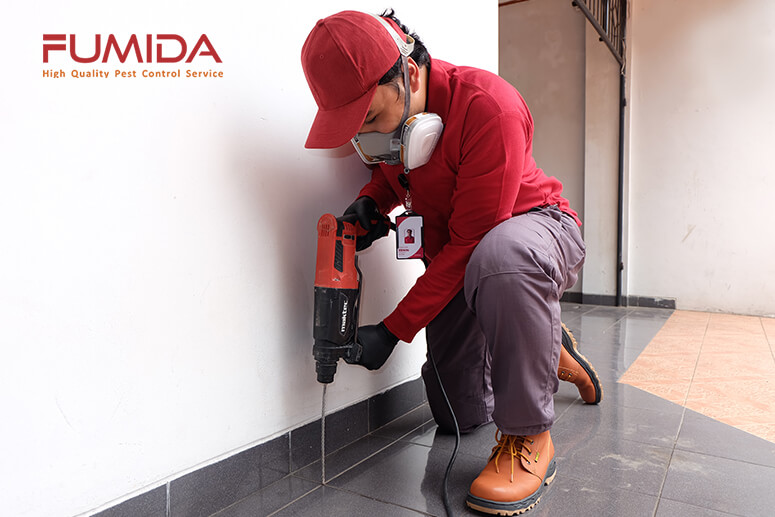
The trench is dug. The rod is then inserted. The chemical injection process is carried out. The technician then moves sixty centimeters before repeating the procedure. Exterminators and homeowners alike think of this ritual, which is performed thousands of times each year throughout Greater Jakarta, as a established technology. It's not. It is not. Soil treatment for subterranean termites originated in temperate climates that have different soil textures, different water regimes, and various target species. The termites were transplanted to Jakarta's compacted silty clay, monsoon rain and Coptotermes gestroi's behavior of foraging, the traditional trench-and-drench produces outcomes that vary from sporadic suppression to complete futility. Greater Jakarta must have soil treatment protocols calibrated according to Greater Jakarta’s conditions. The following 10 tips will help to distinguish chemical applications that merely creates bill lines, and treatment that actually blocks termites.
1. Chemical Mobility is determined by Soil Texture
The Jakarta's urban soils are primarily composed of silty clay. The size of particles is very small. Organic material is very low. Porosity is minimal. The termiticides that are applied in liquid form to the substrate don't disperse radially as they do on loamy sands. They pool in the trench and migrate in a preferred path, namely cracks and utility trenches, as well as roots channels. Exterminators who think that their distribution is uniform are deluding themselves. Post-application verification is based on soil core samples not faith.
2. The 300 to 500mm Moisture Belt determines the best placement
Roof eaves guard the soil surrounding the wall of foundation. It gets little rain. It remains dry than garden soil that is open. Termites are active in the area between 300 to 500 millimeters from the structure. This distance allows them to reach the foundation, but they do not receive any water. Treatments for soil which are applied flush to a wall won't reach this belt. The most effective protocols position the trench along the drip line, not at the foundation line.
3. Hydrolysis Half-Life is measured in weeks, not months.
The process of hydrolysis is by which fipronil (imidacloprid), bifenthrin, and imidacloprid are broken down. Hydrolysis rate increases as the temperature increases and the moisture levels increase. Jakarta's soil temperature averages 28-32degC at shallow depth. The soil's moisture is higher than 20% during the majority of the wet season. Chemical half-lifes are affected by this. Bekasi is four months from Ohio and products with a 12-month labeled efficacy maintains its field effectiveness. Warranty documents must reflect this. Most do not.
4. Vertical Barriers require horizontal disruption
Termites enter through the soil-foundation interface. Treatment of soil only forms an effective chemical barrier vertically when chemicals are present on the interface. Surface injection of rods deposits chemical, but it does not treat the first 5-10 centimeters. Exterminators that punch rods down to the subsoil and then pull them up immediately treat the subsoil and leaving the topsoil undisturbed.
5. C-Organic content bonds and inhibits
Organic matter in soil adsorbs repellent termiticides reducing their concentration for termites to absorb. The soils of Jakarta have a low organic carbon content. However, the landscape planting beds close to foundations are typically altered with compost or potting mix. In these areas, soil treatment requires higher rates of application to overcome organic binding. Standard label rates assume that the soil is unmodified. mineral soil.
6. Pre-treatment Moisture Audits Are Non-Negotiable
Habitats develop when soil water is higher than 22 percent. A soil water content of less than 10% reduces chemical pick-up and hinders foraging. Pesticides who inject terminicide without measuring soil moisture are applying chemistry under unknown conditions. The moisture meter is priced at two hundred thousand Rupiah. The cost of the first retreatment is 10 times more due to incorrect application conditions.
7. Linear meter must not be used to calculate trench volume.
Indonesian soil treatment quotations are generally priced per linear meter foundation. The label instructions specify the volume and concentration per units of area or linear meters for specific trench dimensions. Pest control companies that offer per meter before verifying the depth and width of trenches are selling conformity documentation, not treatment. The volume of chemicals needed for a 15cmx15cm trench is approximately half of the amount needed to treat a trench that is 30 cmx30cm deep. This is seldom seen in the price variation.
8. Trenching Versus Rodding: A Species Specific Selection
Coptotermes gestroi grazes in the soil's upper 15-20cm. Microtermes accesses moisture in dry times by using vertical shafts foraging deeper. Rod injection deposits chemical at depth, intercepting Microtermes. Mixing and trenching chemicals on the upper side will stop the Coptotermes. Species identification must precede protocol selection. Exterminators who employ the same soil treatment procedure on every account are not matched to Jakarta's diversity of species most of the time.
9. Re-treatment Intervals Are Shorter Than Marketing Claims
The Indonesian pest control industry is competitive. Warranty periods have inflated as a sales tactic. Three-year guarantees on soil treatments are not uncommon. Under Jakarta's conditions, a 12- to 18-month time frame for exclusion is suggested. It is true that home owners are experiencing termite infestations in the month twenty two is not unusual; they are in line with the plan. Customers are re-engaged by exterminators who honor their warranties until month 22 without arguing about coverage. Exterminators that dispute coverage are losing clients.
10. The only way to guarantee quality is by sampling soil after treatment.
The exterminator says the trench was dug to correct depth The chemical was mixed to proper concentration, and the injection was performed at the correct pressure and distribution was consistent. The homeowner does not have any way to verify. Verification can be done by using soil cores which have been examined to determine the level of active ingredients. This service is offered. It's affordable. Jakarta anti-termite businesses that request soil samples from a third-party and provide their results to customers are differentiating themselves by proving. Services that don't conduct soil sampling differ on their faith. Markets are increasingly searching for proof.
Conclusion
Since they are familiar, soil treatment protocols within Greater Jakarta continue to be utilized. Familiarity does not equal efficacy. To achieve the same chemical distribution the silty-compressed clay of the city requires a greater trench size as compared to loamy soils. The monsoon-influenced climate in the city can cause a reduction in hydrolysis time and requires shorter warranty periods and regular retreatment cycles. The species assemblage of this region requires a protocol differentiation by pre-treatment classification. Landscape planting beds need organic carbon adjustments and higher application rates. The geometries for its foundations require trenches to be dug at the dripline rather than the wall line. Jakarta anti-termite treatments that keep executing soil treatments according to manufacturer labels written for Ohio, Texas, or Osaka are guaranteeing suboptimal outcomes. The results are not the fault of the manufacturers or the exterminator who did not adjust to the local climate. The process of adaptation involves investing in soil humidity meters, sensors for core sampling, laboratory connections as well as technician training in species recognition. In a mature market, these investments are crucial. The entry fee is which must be taken seriously. Homeowners can distinguish between exterminators from Greater Jakarta who paid this fee and those that did not. They can prove this by accepting more expensive proposals from the former and refusing lower ones from the latter. Follow the top rated anti rayap jakarta for more advice including pest control jakarta selatan, cara basmi rayap, jasa basmi hama, cara membasmi rayap di lemari kayu, membasmi rayap, cara basmi rayap kayu, rumah rayap, rayap adalah, pembasmi rayap kayu, lemari anti rayap and more.
